

King Herod’s Places to Visit in Israel
King Herod’s places to visit in Israel include Masada, Herodium, Caesarea and the Western Wall in Jerusalem, all built or rebuilt by Herod the Great, who ruled Judea for Rome from 37 to 4 BCE. Most are national parks open to visitors today, and several can be combined in a single day from Jerusalem.
Two thousand years after his death, Herod is still the most ambitious builder this land has ever known, and also the king remembered in the Christmas story. Below you will find who he was, what the Bible and history say about him, and a site-by-site guide with practical tips for seeing his legacy for yourself.
| Site | Region | What Herod built | Time from Jerusalem |
| Temple Mount, Western Wall and Southern Wall | Jerusalem | The expanded Temple platform and its massive retaining walls | In the city |
| Tower of David | Jerusalem | Towers guarding his palace, including the base of Phasael tower | In the city |
| Israel Museum | Jerusalem | Model of Second Temple Jerusalem and finds from his tomb | In the city |
| Herodium (Herodion) | Judean Desert, south of Jerusalem | Palace-fortress on a raised hill, and his tomb | About 20 to 30 minutes |
| Masada | Dead Sea | Hanging Northern Palace, bathhouses, storerooms | About 1.5 hours |
| Caesarea | Mediterranean coast | Harbor city, palace, theater, hippodrome, aqueduct | About 1.5 hours |
| Cave of the Patriarchs | Hebron | Monumental enclosure walls | About 45 minutes |
| Sebastia (ancient Samaria) | Samaria | Temple to Augustus | About 1.5 hours (coordinated visits) |
| Banias area | Golan Heights | Temple to Augustus | About 3 hours |
These sites stretch from the Mediterranean to the Dead Sea, which is why many travelers choose private tours in Israel to see several of them without rushing.
Who Was King Herod?
Herod the Great was the Roman-appointed king of Judea who ruled from 37 BCE until his death in 4 BCE. He was born around 73 BCE to Antipater, an Idumean official at the Hasmonean court, and Cypros, a noblewoman from the Nabataean kingdom.
When the Parthians invaded in 40 BCE, Herod fled to Rome, where the Senate declared him king of Judea. It took him three years of fighting to capture Jerusalem and take the throne. From then on he balanced two masters: Rome, and a Jewish population that never fully accepted him.
Herod was a brilliant administrator and a loyal ally of Emperor Augustus. He was also suspicious, violent and ruthless toward anyone he saw as a threat. Is he a historical figure or a legend? He is very real: the historian Josephus describes his life in detail, and his name appears on coins and inscriptions found across the country.
Was King Herod Jewish?
By religion, yes. The Idumeans, a people living south of Judea, were converted to Judaism by the Hasmonean ruler John Hyrcanus in the late 2nd century BCE, and Herod grew up in that tradition. He kept Jewish practices in public, avoided images on his Jewish coins, and rebuilt the Temple in Jerusalem on a grand scale.
Yet many of his subjects saw him as an outsider: half Idumean, half Nabataean, and loyal first to Rome. He married into the Hasmonean royal family partly to gain legitimacy, but he never shook off the label of a foreign king.
Herod’s Family and the Killing of His Sons
Herod married ten times, and his court was a battlefield of jealousy and plots. In 29 BCE he executed his beloved Hasmonean wife, Mariamne, after accusations of betrayal. In 7 BCE he had their two sons, Alexander and Aristobulus, strangled. Days before his own death he ordered the execution of his eldest son, Antipater.
The brutality became a joke in Rome. Augustus is said to have remarked that it was safer to be Herod’s pig than his son, a pun on the Greek words for pig and son, and a reminder that a Jewish king would not eat pork.
How Did King Herod Die?
Herod died in Jericho in 4 BCE, at about 69, after a long and painful illness. Josephus describes fever, unbearable itching, swelling, breathing difficulty and intestinal pain. Modern researchers have suggested chronic kidney disease with severe complications, though no diagnosis can be certain.
According to Josephus, his body was carried in a grand funeral procession from Jericho to Herodium, the fortress he had built for himself. In 2007 archaeologist Ehud Netzer announced that he had found the tomb there, which you can visit today (see the Herodium section below).
Which Herod Is Which?
The New Testament mentions several Herods, which confuses many readers. Here is the short version:
| Name | Ruled | Where | Known for |
|---|---|---|---|
| Herod the Great | 37 to 4 BCE | All of Judea | Builder of the Temple, Masada and Caesarea; the king at Jesus’ birth |
| Herod Archelaus | 4 BCE to 6 CE | Judea and Samaria | His son; removed by Rome after a harsh rule |
| Herod Antipas | 4 BCE to 39 CE | Galilee and Perea | Executed John the Baptist; met Jesus before the crucifixion; founded Tiberias and rebuilt Tzippori |
| Herod Agrippa I | 41 to 44 CE | Most of his grandfather’s kingdom | Persecuted the early church; died in Caesarea (Acts 12) |
So which Herod ruled when Jesus was born? Herod the Great. The Herod who appears in the story of Jesus’ trial is his son, Herod Antipas.
King Herod in the Bible
Herod appears in the Gospel of Matthew, chapter 2. According to Matthew, Magi from the east arrived in Jerusalem asking where the newborn “king of the Jews” could be found, because they had seen his star. Herod consulted the priests and scribes, learned that the Messiah was to be born in Bethlehem, and asked the Magi to report back so he too could “worship” the child.
Warned in a dream, the Magi went home another way. Matthew then describes Herod ordering the killing of all boys aged two and under in and around Bethlehem, an event Christians remember as the Massacre of the Innocents. Joseph, also warned in a dream, fled to Egypt with Mary and Jesus, and returned only after Herod died.
No other ancient source records the massacre. Historians note that Bethlehem was a small village, so the number of victims would have been small, and that the story fits well with what Josephus tells us about Herod’s paranoia. For believers, it is the dark backdrop to the Nativity. Many pilgrims on Christian tours to Israel visit Herodium, just a few miles from Bethlehem, to see where this king chose to be buried.
Why Did Herod Want to Kill Jesus?
In Matthew’s account, Herod saw the child as a rival. Herod himself held the title of king of the Jews, and the Magi’s news of a newborn king, linked to messianic prophecy, threatened his throne. A ruler who had executed his own wife and sons would not hesitate to remove a possible claimant, however young.
How Old Was Jesus When Herod Died?
Jesus was probably a small child, around one or two years old. Herod died in 4 BCE, and Matthew places Jesus’ birth during Herod’s reign, so most scholars date the Nativity to about 6 to 4 BCE. The odd result, that Jesus was born “before Christ”, comes from a miscalculation in the calendar created by the monk Dionysius Exiguus in the 6th century.
What Happened to King Herod in the Bible?
Matthew simply reports that Herod died, and that an angel told Joseph it was safe to return. Joseph learned that Herod’s son Archelaus now ruled Judea and, afraid of him, settled the family in Nazareth in the Galilee instead.
Herod’s Building Legacy: Why His Sites Still Impress
To understand King Herod’s places to visit in Israel, start with his building style. Herod combined Roman engineering with local stone, and his work is easy to spot: enormous limestone blocks with smooth, flat borders (called drafted margins) around a raised center. He loved water in the desert, building pools, bathhouses and cisterns where nobody thought they were possible.
His Jewish subjects disliked the man but admired the builder. The Talmud records the saying that whoever has not seen Herod’s Temple has never seen a beautiful building (Bava Batra 4a).
Herod’s Jerusalem
Jerusalem holds the most important and most visited of all Herod’s works. You can see them in one full day.
The Temple Mount and Herod’s Temple
From about 20 BCE, Herod rebuilt the Second Temple and doubled the size of the platform around it, creating the vast esplanade known today as the Temple Mount. To do it, he built huge retaining walls down into the valleys and filled the space between with earth and vaulted chambers. The Temple itself was destroyed by the Romans in 70 CE, but the platform still shapes the skyline of the Old City.
The Western Wall and the Western Wall Tunnels
The Western Wall, Judaism’s holiest place of prayer, is a section of Herod’s western retaining wall. The lower courses of large, drafted stones are his.
The Western Wall Tunnels let you follow the same wall underground for about 450 meters. Here you see the most impressive stone of all: a single block about 13.5 meters long that weighs hundreds of tons. Tunnel visits are by guided tour only and must be booked in advance through the Western Wall Heritage Foundation.
Southern Wall Excavations and the Davidson Center
At the Jerusalem Archaeological Park, next to the Western Wall plaza, you can walk on the paved Herodian street that ran along the wall, and see the piles of stones thrown down by the Romans in 70 CE. On the south side, the broad steps once led pilgrims up to the Temple gates. A replica of the “place of trumpeting” inscription marks where a priest stood to announce the Sabbath. The Davidson Center at the entrance has a helpful film and models.
Tower of David
The citadel near Jaffa Gate is called the Tower of David, but its oldest standing tower rests on the base of one of three towers Herod built to protect his palace. The museum, reopened after a major renovation, tells the city’s whole story, and its ramparts give one of the best views over the Old City.
The Israel Museum: Model of Jerusalem and Herod’s Finds
The Israel Museum’s 1:50 scale Model of Jerusalem shows the city in the late Second Temple period, with Herod’s Temple at its center. It is the best way to picture what the walls you saw in the Old City once supported. The museum’s archaeology wing displays finds from Herod’s reign, including objects from Herodium. Check in advance which Herod items are currently on show.
If Jerusalem is the heart of your trip, private Holy Land tours can link these sites with the Mount of Olives and the City of David at a comfortable pace.
Herodium (Herodion): Herod’s Palace-Fortress and Tomb
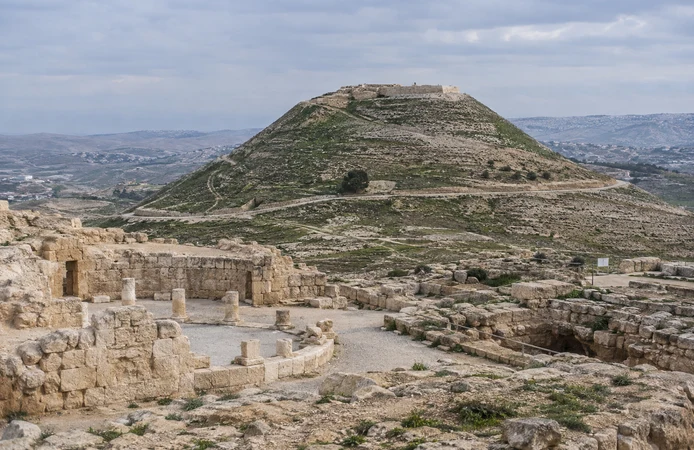
Herodium is the cone-shaped hill you can see on the horizon south of Jerusalem, and it is the most personal of Herod’s creations. In 40 BCE, fleeing Jerusalem with his family, Herod fought off his pursuers at this spot. Years later he returned to build a palace-fortress here and named it after himself. Unlike Masada or Jericho, where he expanded older Hasmonean forts, Herodium was entirely his own design.
He raised an existing hill and shaped it into a perfect cone, then built a round fortress at the top with four towers, a courtyard garden, a bathhouse and living quarters. At the foot of the hill lay Lower Herodium, a royal town with a huge pool, gardens and official buildings.
What You See Today
A path and steep stairs lead to the summit, where you walk through the remains of the palace, a Roman-style bathhouse and a room later turned into a synagogue. The view takes in Jerusalem, Bethlehem and the Judean Desert all the way down toward the Dead Sea.
From the top, you descend into the hill through huge cisterns and tunnels. During the Great Revolt (66 to 73 CE) and especially the Bar Kokhba Revolt (132 to 135 CE), Jewish rebels used Herodium as a base and dug these tunnels to move unseen. You exit on the slope near Herod’s small royal theater and the site of his mausoleum, where a reconstructed section of the tomb and its base stand on a viewing platform.
The Search for Herod’s Tomb
Josephus wrote that Herod was buried at Herodium, but for decades nobody could find the grave. Archaeologist Ehud Netzer of the Hebrew University searched for more than 30 years, and in 2007 he found the mausoleum on the hill’s northeastern slope, with fragments of a decorated stone sarcophagus he identified as Herod’s. Tragically, Netzer died in 2010 after a fall at the site. Some scholars have since argued that the sarcophagus belonged to a family member rather than Herod himself, but the identification of the tomb is widely accepted.
Visiting Herodium
- Location: Judea and Samaria, about 12 km (7.5 miles) south of Jerusalem and about 20 to 30 minutes by car. The site is a national park run by the Israel Nature and Parks Authority and is visited on regular private tours.
- Hours (at the time of writing): summer, Sunday to Thursday and Saturday 8:00 to 17:00, Friday and holiday eves 8:00 to 16:00; winter, one hour earlier. Last entry is one hour before closing.
- Tickets (at the time of writing): adult ₪31, child ₪16. Reserving in advance through the Parks Authority website is recommended.
- Time needed: 1.5 to 2 hours, including the short film at the entrance.
- Tips: the stairs are steep and the tunnels are dim and narrow in places, so bring good shoes, a hat and water. Children love the tunnels; a small flashlight adds to the fun.
Masada: Herod’s Desert Palace Above the Dead Sea
Masada is a flat-topped mountain rising about 400 meters above the Dead Sea shore, and it is the most spectacular of all Herod’s sites. The Hasmoneans had a small fort here, but Herod turned it into a fortified royal retreat between about 37 and 31 BCE. According to Josephus, he wanted a refuge in case of a Jewish uprising or an attack by Cleopatra of Egypt, who coveted his kingdom.
Herod’s Palaces on the Rock
The highlight is the Northern Palace, which hangs off the cliff in three terraces. The top level held Herod’s private rooms, while the lower two were for leisure, with columned halls and wall paintings imitating marble that still keep their colors. Elsewhere on the summit you can see the larger Western Palace, a full Roman bathhouse with hot, warm and cold rooms, long storerooms for food, wine and weapons, and huge cisterns cut into the rock that collected floodwater from the desert.
The Last Stand at Masada
Seventy years after Herod’s death, his fortress became a symbol for a different reason. During the Great Revolt against Rome, Jewish rebels held Masada until about 73 or 74 CE. The Roman Tenth Legion surrounded the mountain with camps and built a massive siege ramp on the western side, which you can still see. Josephus writes that the 960 defenders chose death over slavery. Archaeologists debate parts of his account, but Masada remains a powerful place of Jewish memory. It was declared a UNESCO World Heritage Site in 2001.
Many families mark a milestone here: you can celebrate a Bar or Bat Mitzvah on Masada in the ancient synagogue on the summit, one of the oldest in the world.
Visiting Masada
- Location: Masada National Park, on the western shore of the Dead Sea, about 1.5 hours from Jerusalem.
- Getting up: the cable car takes about three minutes. Hikers can climb the Snake Path from the east (about 45 to 60 minutes uphill) or the shorter Roman ramp path from the west side.
- Best time: in summer, start at sunrise. The Snake Path opens before dawn, and trails may close in extreme heat. Hours, cable car times and fees change with the season, so check the Israel Nature and Parks Authority website before you go.
- Time needed: 2.5 to 3 hours, plus time for the site museum at the base.
- Extras: an evening sound-and-light show runs on the western side on selected nights.
Nearby Dead Sea Stops
Combine Masada with a float in the Dead Sea and a walk at the Ein Gedi nature reserve, about 20 minutes north. South of Masada you can hike Mount Sodom and see the Lot’s Wife pillar of salt, a striking link between the desert landscape and the stories of Genesis.
Caesarea: Herod’s Harbor City on the Mediterranean
Between about 22 and 10 BCE, Herod transformed a small coastal town into Caesarea, a gleaming Roman city named in honor of Augustus. Its centerpiece was Sebastos, a deep-water harbor built on an open coast with no natural bay. Herod’s engineers poured hydraulic concrete, made with volcanic ash shipped from Italy, into wooden frames sunk in the sea. It was one of the largest artificial harbors of the ancient world.
After Herod’s death, Caesarea became the capital of Roman Judea and the seat of its governors, including Pontius Pilate. It also plays a part in the New Testament: Peter baptized the centurion Cornelius here, Paul was held prisoner here for two years, and Herod’s grandson Herod Agrippa I collapsed and died in the city’s theater (Acts 12).
What to See in Caesarea National Park
- The theater: Herod’s restored Roman theater still hosts concerts. A replica of the Pilate Stone, the only known stone inscription from his time that names him, stands nearby; the original is in the Israel Museum.
- The Promontory Palace: Herod’s seaside palace jutted into the water, with a pool at its center surrounded by colonnades.
- The hippodrome: a long arena by the sea where crowds watched chariot races and games.
- The harbor: the remains of Sebastos lie mostly underwater; the harbor area now has restaurants, shops and a short film on the city’s history.
- The aqueduct: a short drive north, Aqueduct Beach shows the arches of the channel that carried spring water about 15 km to the city. It is a favorite sunset spot.
Visiting Caesarea
- Location: on the coast between Tel Aviv and Haifa, about 1 hour from Tel Aviv, 1.5 to 2 hours from Jerusalem, and about 45 minutes from Ben Gurion Airport.
- Time needed: 2 to 3 hours for the national park, plus time at the aqueduct.
- Tips: check the park website for hours, fees and the concert calendar. Caesarea fits perfectly on a day heading north to Haifa and the Galilee, or on your last afternoon before an evening flight.
More Herodian Sites to Visit
Beyond the big four, Herod left his mark across the land. Some of these sites are easy to add to a tour; others require special arrangements or depend on current conditions, so plan them with an expert.
Cave of the Patriarchs, Hebron
According to Genesis, Abraham bought the Cave of Machpelah as a family tomb, and Jewish, Christian and Muslim tradition holds that Abraham, Isaac, Jacob, Sarah, Rebecca and Leah are buried there. Herod built the massive rectangular enclosure around the cave, with walls rising about 12 meters. It is the most complete Herodian building still standing, and its drafted stones look just like those of the Western Wall. Hebron is in Judea and Samaria, about 45 minutes from Jerusalem; visits are made with organized tours, and current security guidance should always be checked first.
Sebastia (Ancient Samaria)
On the hill of Samaria, once the capital of the biblical Kingdom of Israel, Herod refounded the city in 27 BCE and named it Sebaste, Greek for Augustus. He crowned it with a temple to the emperor, whose monumental staircase still survives, along with a colonnaded street and theater. Access depends on current conditions in the area.
Desert Fortresses: Cypros, Hyrcania and Alexandrium
Herod guarded the routes between Jerusalem, Jericho and the Jordan Valley with a chain of hilltop forts. Cypros, above Jericho, was named after his mother. Hyrcania, deep in the Judean Desert, served as a prison. Alexandrium, on a peak overlooking the Jordan Valley, was where his executed sons were buried. These are mostly ruins, best seen from viewpoints or on specialist desert hikes.
In the North: Herod’s Temple to Augustus
In 20 BCE Augustus gave Herod the region around the springs of Banias, at the foot of Mount Hermon, and Herod built a white marble temple to the emperor nearby. Archaeologists still debate whether it stood at Banias itself or at Omrit, a few kilometers south. Banias Nature Reserve is a beautiful stop on any Golan Heights day.
A Sample 3-Day “In Herod’s Footsteps” Itinerary
Three days are enough to see the highlights in a logical order without rushing.
- Day 1: Herod’s Jerusalem. Morning at the Western Wall and a booked tour of the Western Wall Tunnels. Late morning at the Southern Wall excavations and the Davidson Center. Afternoon at the Israel Museum and the Model of Jerusalem, then sunset from the Tower of David ramparts.
- Day 2: Herodium, Masada and the Dead Sea. Early start at Herodium, just south of Jerusalem. Continue down to the Dead Sea for Masada (cable car or hike), lunch, and a float in the Dead Sea. Optional stop at Ein Gedi before returning or staying overnight by the sea.
- Day 3: Caesarea. Drive to the coast for Caesarea National Park and the aqueduct. From here, continue north to Haifa and the Galilee, or head to Ben Gurion Airport, about 45 minutes away.
Every day can be reordered, slowed down or extended, for example with Hebron, the Galilee sites of Herod Antipas, or the Banias springs in the Golan Heights. You can also build Herod’s sites into one of our longer private Israel tour packages.
Tips for Visiting Herod’s Sites
- Best seasons: March to May and October to November bring mild weather at the desert sites. Summer is very hot at Masada and Herodium, so start at opening time.
- Book ahead: reserve the Western Wall Tunnels and, in busy seasons, Herodium and other national parks.
- Save on entry: if you plan to visit several national parks, the Israel Pass from the Israel Nature and Parks Authority can lower the total cost.
- Dress modestly: cover shoulders and knees at the Western Wall and the Cave of the Patriarchs.
- Pack for the desert: sturdy shoes, a hat, sunscreen and plenty of water, even in winter.
- Check the calendar: sites close early on Fridays and holiday eves, and some may close on Jewish holidays.
- Stay updated: for Herodium, Hebron and Sebastia, check the latest security guidance before you go.
- Traveling with kids: the Herodium tunnels, the Masada cable car and the Caesarea harbor are big hits with children. See our sample family itinerary for Israel for more ideas.
Let Us Plan Your Herod Tour, From Airport to Airport
Herod’s sites stretch from the Mediterranean coast to the shores of the Dead Sea. Park hours change with the seasons, Masada’s trails can close in the heat, the Western Wall Tunnels need booking weeks ahead, and sites in Judea and Samaria call for the right route and the right guide. Planning it all yourself takes time and leaves room for missed connections.
At Dekel Tours, we take care of everything. We meet you at Ben Gurion Airport, drive you in a private air-conditioned vehicle, and pair you with a licensed private Israel tour guide who brings Herod’s story to life at every site. We handle tickets and reservations, choose hotels that fit your style, time each visit to avoid the heat and the crowds, and build the route around the places you most want to see. When your trip is over, we bring you back to the airport.
Book your flight to Israel. We will take care of everything else, from the moment you land until we drop you back at the airport.
Every tour is custom-made: for families, Bar and Bat Mitzvah celebrations, church groups, history lovers, or travelers who want to continue north to the Galilee and the Golan Heights. Tell us which of Herod’s sites you want to see and how many days you have, and we will design your private tour.
Private, flexible, and always updated on current access and safety conditions.
Final Thoughts
From the stones of the Western Wall to the hanging palace of Masada and the harbor of Caesarea, Herod left a landscape of wonders behind him. His reputation is dark, but the places he built still let you walk straight into the world of the Second Temple, the Gospels and the Jewish revolts against Rome.
If you are ready to explore King Herod’s places to visit in Israel with an expert at your side, contact our team and we will start planning your journey.
Herod died in Jericho in 4 BCE, at about 69, after a long and painful illness described by the historian Josephus. Modern researchers have suggested chronic kidney disease with severe complications. His body was carried in a royal procession to Herodium, where archaeologists identified his tomb in 2007.
Yes, three of them. Herod had his sons Alexander and Aristobulus, born to his wife Mariamne, executed in 7 BCE, and ordered the death of his eldest son, Antipater, just days before he himself died in 4 BCE. Years earlier he had also executed Mariamne.
By religion, yes. Herod’s Idumean family had converted to Judaism under the Hasmonean rulers, and he kept Jewish practice in public and rebuilt the Temple in Jerusalem. Still, his Idumean and Nabataean roots and his loyalty to Rome led many Jews of his time to see him as a foreign king.
Jesus was probably about one or two years old. Herod died in 4 BCE, and since the Gospel of Matthew places Jesus’ birth during Herod’s reign, most scholars date the Nativity to about 6 to 4 BCE.
According to the Gospel of Matthew, the Magi told Herod that a new “king of the Jews” had been born in Bethlehem. Herod, who held that title and feared any rival, ordered the killing of the town’s young boys. Warned in a dream, Joseph escaped with Mary and Jesus to Egypt.