

Why Is the Church of the Holy Sepulchre Important?
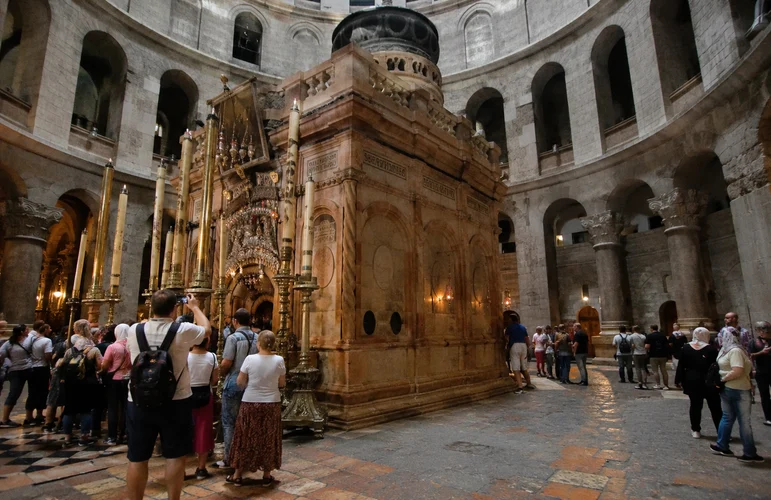
To understand exactly why is the church of the holy sepulchre important, you first need to recognize what Christians believe occurred at this specific location. The church stands on the traditional sites of Jesus Christ’s Crucifixion at Golgotha, his burial, and his Resurrection. Located in Jerusalem’s Old City, this vast complex encloses the Tomb of Jesus (the Aedicule) and the Rock of Calvary, making it one of the most sacred pilgrimage destinations in the world for Christian believers.
What Is the Church of the Holy Sepulchre?
Located in the Christian Quarter of Jerusalem’s Old City, the Church of the Holy Sepulchre is widely considered the holiest site in Christianity. It encompasses the locations historically associated with the final events of Jesus’ earthly life: his Crucifixion, preparation for burial, entombment, and Resurrection. For approximately 1,700 years, it has served as a major Christian pilgrimage destination. The building visitors see today is a massive, complex structure containing architectural layers from multiple historical periods, reflecting centuries of devotion, destruction, and rebuilding.
Why Is the Church of the Holy Sepulchre Important to Christians?
When asking why is the church of the holy sepulchre important, the answer lies in its association with the three most central events of the Christian faith.
The Crucifixion at Golgotha
Golgotha, also known as Calvary, translates to “place of the skull” in Aramaic. Christian tradition identifies a specific location inside the church as the exact site where Jesus was crucified. Today, the Rock of Calvary remains visible, encased in glass beneath an ornate altar. Pilgrims can approach this altar and reach through an opening to touch the rock itself. For Christians, the Crucifixion is fundamental to beliefs surrounding sacrifice, redemption, forgiveness, and salvation.
The Burial of Jesus
According to the New Testament, Jesus’ body was taken down from the cross and placed in a nearby tomb by Joseph of Arimathea. The Gospel of John (19:41–42) explicitly states that the tomb was close to the place of the Crucifixion. This biblical proximity is crucial for understanding how the modern church can enclose what was originally a much larger outdoor landscape.
The Resurrection and the Empty Tomb
Christian tradition identifies the tomb enclosed within the church as the place where Jesus was buried and subsequently rose from the dead. Today, this tomb is surrounded by a specialized shrine known as the Aedicule. Because the Resurrection is the ultimate heart of Christian belief, entering the Aedicule is often the emotional and spiritual climax for those participating in Christian tours of Israel.
The Most Important Sacred Sites Inside the Church
Golgotha / Calvary
This area marks the traditional location of the Crucifixion. The exposed Rock of Calvary sits directly beneath the Altar of the Crucifixion, serving as a highly venerated focal point for visiting pilgrims.
The Stone of Anointing
Located near the church’s entrance, this large slab is traditionally associated with the preparation of Jesus’ body for burial, where it was washed and anointed. While the present stone is a later addition to commemorate this event, it is a deeply emotional site. Visitors frequently kneel beside the stone to pray, touch it, or place personal religious objects upon it to receive a blessing.
The Aedicule and the Tomb of Jesus
The Aedicule is a small, elaborate chapel situated beneath the church’s Rotunda, enclosing the traditional burial place of Jesus. Pilgrims can enter its small inner chamber to pay their respects. During a major restoration in 2016 and 2017, samples of mortar taken from between the original limestone surface and a marble covering slab were dated to approximately 345 CE. While this does not scientifically prove the tomb belonged to Jesus, it strongly supports the historical sequence of a Christian sanctuary existing here during the Constantinian period.
The Final Stations of the Via Dolorosa
The Via Dolorosa is the traditional route Jesus walked toward his execution. The final Stations of the Cross end directly inside the Church of the Holy Sepulchre. This makes the church the ultimate destination of Jerusalem’s most famous Christian pilgrimage path.
How Old Is the Church of the Holy Sepulchre?
The church you see today is mostly about 900 years old (dating back to the 12th-century Crusader period), but the original site itself was first built approximately 1,700 years ago (in the 4th century CE). The history of the structure is complex and involves many cycles of building, destruction, and restoration over the centuries.
Constantine and Saint Helena
In the early fourth century, the Roman Emperor Constantine embraced Christianity and commissioned a major religious complex at this site, which was dedicated around 335 to 336 CE. Christian tradition associates Constantine’s mother, Saint Helena, with identifying these holy locations, as well as discovering the True Cross of Christ’s Crucifixion.
Persian Conquest
The Constantinian complex suffered heavy damage by fire during the Persian conquest of Jerusalem in 614 CE.
Destruction in 1009
The church was subjected to severe destruction in 1009 by the Fatimid caliph al-Hakim. Significant portions of the complex, including the original tomb structure, were destroyed.
Byzantine Reconstruction
During the 11th century, rebuilding efforts took place under the Byzantine emperor Constantine IX Monomachus.
Crusader Period
After the Crusaders captured Jerusalem in 1099, they undertook a massive rebuilding and reorganization of the church, consecrating the Romanesque structure in the 12th century (1149). Much of the layout visitors navigate today dates from this Crusader reconstruction.
Fire and Modern Restoration
A major fire partially destroyed the church in 1808, leading to a new reconstruction dedicated in 1810. Numerous conservation projects have occurred since, most notably the crucial restoration of the Aedicule in 2016 and 2017.
Is the Church Really Where Jesus Was Crucified and Buried?
The short answer is that while it cannot be proven with absolute scientific certainty, historically and archaeologically, this is the most likely site, and no competing location possesses stronger evidence.
Christian tradition has identified this specific area with Jesus’ Crucifixion and burial since at least the fourth century. From an archaeological perspective, evidence indicates that this area was utilized as a stone quarry and contained rock-cut tombs during the first century. Furthermore, archaeological remains suggest that this site was situated just outside the second north wall of ancient Jerusalem at the time of Jesus. Because Roman law dictated that crucifixions and burials occur outside the city walls, the archaeological landscape is perfectly compatible with the New Testament accounts.
While archaeology cannot identify a particular first-century tomb occupant as Jesus with absolute scientific certainty, no rival site is supported by comparable historical evidence. The Garden Tomb, for instance, was proposed in the 19th century as an alternative Protestant site, but the Church of the Holy Sepulchre holds a much older, continuous historical tradition.
Why Are Golgotha and Jesus’ Tomb Inside the Same Church?
Modern visitors are often surprised to find the Altar of the Crucifixion, the Stone of Anointing, and the empty tomb all inside a single building. During the first century, there was no church here; it was entirely an outdoor landscape. Golgotha was a rocky hill, and the nearby quarry walls contained carved rock tombs. When the massive Christian church complex was constructed centuries later, it was built large enough to enclose both the crucifixion hill and the tomb within its walls.
Why Was the Church Built Here?
Jerusalem was dramatically altered following Roman destruction in 70 CE. During the second century, Emperor Hadrian rebuilt the city as Aelia Capitolina and constructed a Roman temple dedicated to Venus directly over the site. During Constantine’s reign in the fourth century, these Roman structures were torn down. Underneath, a tomb identified by local Christians as Jesus’ burial place was revealed. Consequently, Constantine ordered a monumental Christian basilica to be constructed around these newly uncovered sacred locations.
Who Controls the Church of the Holy Sepulchre Today?
One of the church’s most fascinating features is that no single denomination owns the entire complex. Instead, it is shared by several Christian communities, primarily the Greek Orthodox, Roman Catholic (Franciscans), and Armenian Apostolic churches. The Coptic Orthodox, Syriac Orthodox, and Ethiopian Orthodox churches also maintain rights and access to specific areas.
What Is the Status Quo?
The shared arrangement is strictly governed by the “Status Quo,” a decree originating from the Ottoman Turks in 1757 and formalized in the 19th century. It carefully regulates the control of different chapels, worship schedules, processions, maintenance, and access. Because the rights of each community are so meticulously guarded, even minor physical changes to shared areas require unanimous agreement, making the church a fascinating study in religious coexistence.
The Muslim Families and the Keys to the Church
To maintain neutrality among the Christian denominations, a longstanding tradition dating back to 1246 bestows two local Muslim families with the sole right and responsibility to keep the keys and manage the opening and closing of the church doors every day.
The Immovable Ladder
A famous wooden ladder remains propped on a ledge beneath one of the church’s upper right windows. It has rested there for generations and has become an informal symbol of the Status Quo. Because the different communities possess rigidly defined rights, moving the ladder—or altering any shared property—can provoke disputes. It stands as a physical reminder of the delicate balance required to manage this ancient building.
Why the Church Is Important Beyond Religion
The church holds significance for several reasons beyond theology:
- 1,700 Years of Pilgrimage: Christians globally have traveled here since late antiquity, making it a cornerstone of a church trip to the Holy Land.
- Jerusalem’s Complex History: The building’s physical architecture preserves evidence of Roman, Byzantine, Persian, Islamic, Crusader, Ottoman, and modern Jerusalem.
- Multiple Christian Traditions: Visitors can witness several ancient Christian denominations worshipping, chanting, and wearing distinctive robes all under one roof.
- Archaeology: The site preserves vital data regarding ancient Jerusalem’s city walls and first-century burial practices.
- Living Religious Tradition: The Holy Sepulchre is an active sacred space where communities continue to celebrate Mass, conduct processions, and observe centuries-old religious ceremonies.
The Holy Fire Ceremony
The Holy Fire ceremony is a dramatic event associated with Orthodox Easter. Taking place around the Aedicule inside the Church of the Holy Sepulchre, thousands of worshippers gather to witness the emergence of a flame from the tomb, demonstrating the church’s role as a vibrant, living center of Christian tradition.
Visiting the Church of the Holy Sepulchre Today
The church is located in the Christian Quarter of Jerusalem’s Old City and is accessible on foot through narrow historic streets. Entrance to the church is generally free. Visitors should expect crowds; the Aedicule often has substantial queues of pilgrims waiting to enter. Early mornings can offer a quieter experience, while Holy Week and Easter are intensely busy. As an active religious site, visitors are required to dress modestly—covering shoulders and knees—and respectful behavior is expected. Scheduled religious ceremonies may temporarily affect access to certain chapels.
Why Visit the Church with a Private Guide?
Visiting independently is possible, but understanding nearly 2,000 years of biblical tradition, archaeology, and the Status Quo can be challenging without context. A first-time visitor might encounter altars, staircases, and various religious ceremonies without knowing how Golgotha, the Stone of Anointing, and the Aedicule fit together biblically and historically.
A knowledgeable private guide can connect what you are seeing with the events and traditions behind each location. Through private tours in Israel, Dekel Tours can create a customized Jerusalem itinerary based on your interests, faith background, and pace. A tailored schedule can seamlessly combine the Holy Sepulchre with the Via Dolorosa, the Mount of Olives, the Garden of Gethsemane, and the Western Wall. By managing the logistics, we allow you to focus entirely on experiencing these profound biblical sites.
Why the Church of the Holy Sepulchre Still Matters Today
Ultimately, if you are asking why is the church of the holy sepulchre important, the answer is found in its unparalleled combination of faith, history, and resilience. It is the physical location where Christian tradition roots the Crucifixion, burial, and Resurrection of Jesus. Supported by a landscape that aligns with first-century archaeological practices, it encapsulates 1,700 years of pilgrimage, the complexities of Jerusalem’s history, and the living devotion of multiple Christian traditions worshipping together. To experience this incredible convergence of history and faith for yourself, plan your private Jerusalem tour with our expert team today.
It is a sprawling, ancient religious complex that encloses the holiest sites in Christianity, including the Rock of Calvary, the Stone of Anointing, and the Aedicule containing Jesus’ empty tomb.
The church is located in the Christian Quarter of the Old City of Jerusalem, accessible on foot through the historic, narrow streets of the city.
The original church complex was dedicated around 335 to 336 CE. Following periods of destruction, the current structure dates primarily from a 12th-century Crusader reconstruction and an 1810 restoration.
The first major church on the site was commissioned by the Roman Emperor Constantine the Great in the early 4th century. Later major rebuilds were directed by the Byzantine Emperor Constantine IX Monomachus and the 12th-century Crusaders.
It is vital to Christians because it contains the traditional sites associated with Jesus Christ’s Crucifixion at Golgotha, his preparation for burial, and his Resurrection from the tomb.