

Where Is Nazareth Today? History & Visitor Guide
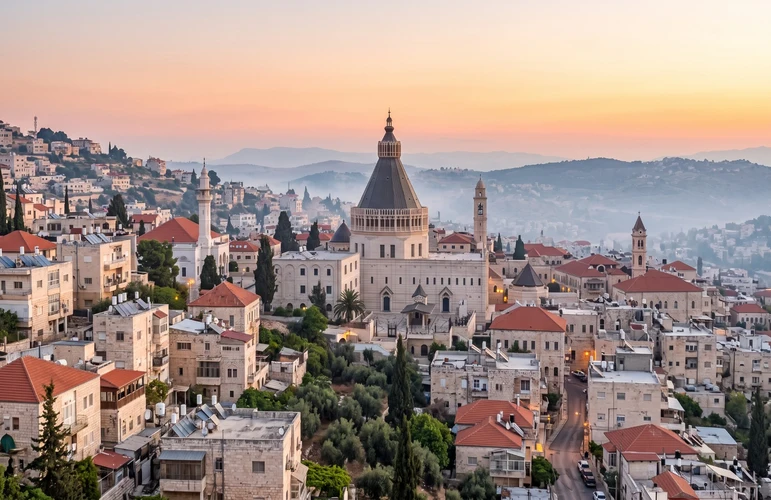
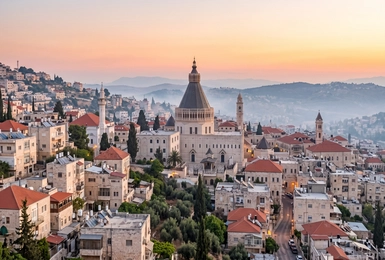
Nazareth is a city in northern Israel, in the Lower Galilee region of the Northern District, about 25 kilometers (15 miles) west of the Sea of Galilee. Known to Christians as Jesus’ childhood home, it is a living Arab city with churches, mosques, markets, and busy residential neighborhoods.
Nazareth at a Glance
| Fact | Detail |
| Country | Israel |
| District and region | Northern District, Lower Galilee |
| Population | About 77,200 in the CBS end-of-2023 table |
| Elevation | Around 350 meters (1,150 feet), varying across the hills |
| Local names | Natzrat or Natzeret in Hebrew; an-Nasira in Arabic |
| Biblical connection | Jesus’ upbringing and the Annunciation in Christian tradition |
| Sea of Galilee | Approximately 25 kilometers (15 miles) away in a straight line |
Where Is Nazareth on the Map?
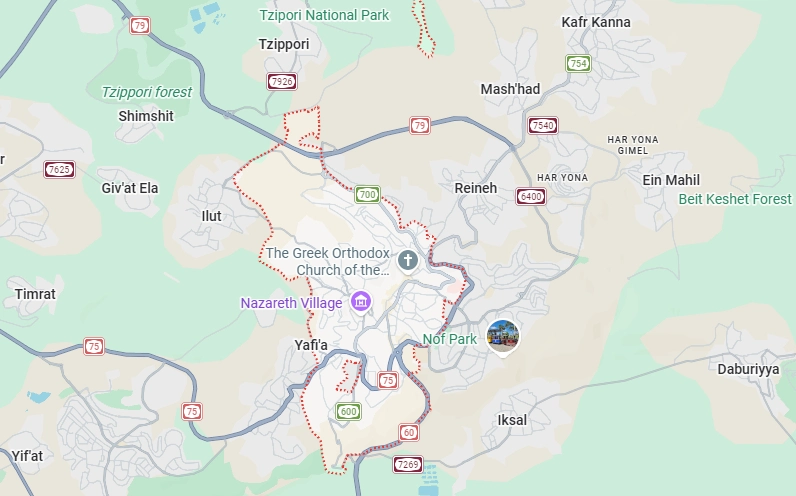
Nazareth is located in the Nazareth Range, among the southern hills of the Lower Galilee. Its center occupies a natural basin, with neighborhoods climbing the surrounding slopes. South of the city, viewpoints look across the Jezreel Valley; Mount Tabor rises roughly 9 kilometers (6 miles) to the east in a straight line.
Is Nazareth in Galilee?
Yes, Nazareth is in the Lower Galilee. This is the southern part of the Galilee hill country, generally lower than the mountainous Upper Galilee farther north.
How Far Is Nazareth From Jerusalem, Bethlehem and the Sea of Galilee?
Straight-line distances explain the geography; road distances help plan your day. Hills, traffic, route choices, and checkpoint arrangements can make the two very different.
| Destination | Approximate road distance | Miles | Planning time by car |
|---|---|---|---|
| Tiberias, on the Sea of Galilee | 30–40 km | 19–25 mi | 40–60 minutes |
| Haifa | 40–50 km | 25–31 mi | 45–75 minutes |
| Tel Aviv | 100–120 km | 62–75 mi | 1.5–2.5 hours |
| Jerusalem | 150–200 km, depending on route | 93–124 mi | 2–3 hours or more |
| Bethlehem, West Bank | 160–220 km, depending on route | 99–137 mi | 2.5–3.5 hours or more, plus possible checkpoint delays |
| Cana, Kafr Kanna | 8–12 km | 5–7 mi | 15–30 minutes |
| Mount Tabor summit area | 20–30 km | 12–19 mi | 35–55 minutes |
| Ben Gurion Airport | 110–135 km | 68–84 mi | 1.5–2.5 hours |
These are broad planning estimates, not live navigation results. Check exact endpoints and permitted routes before departure, including any West Bank roads.
For private tours in Israel, building the day around a few meaningful stops leaves more time to explore and less time in transit.
Is Nazareth in Israel?
Yes. If your question is “where is Nazareth today?” in terms of modern borders, the answer is Israel. It belongs to the Northern District, inside Israel’s pre-1967 borders, and became part of Israel in July 1948.
Nazareth is not in Jerusalem or the West Bank. Bethlehem, associated with Jesus’ birth in the Gospels, is a different city in the West Bank (Judea and Samaria), south of Jerusalem.
Travelers considering a private Holy Land tour that includes both Nazareth and Bethlehem should allow for separate touring days and coordinated checkpoint arrangements.
Nazareth vs. Nof HaGalil (Upper Nazareth)
Nazareth and Nof HaGalil are separate neighboring municipalities. Nof HaGalil developed in the 1950s as Nazareth Illit, often translated as Upper Nazareth, and received its current name in 2019.
The Basilica of the Annunciation, Mary’s Well, and the historic market are in Nazareth.
Who Lives in Nazareth Today?
Nazareth’s residents are predominantly Arab citizens of Israel, with a Muslim majority and a substantial Christian community. Greek Orthodox, Melkite Greek Catholic, Latin Catholic, Maronite, and Protestant communities contribute to its religious life.
The Israel Central Bureau of Statistics lists approximately 77,200 residents at the end of 2023, compared with about 33,300 in 1972. These dated figures describe the city itself, rather than a wider metropolitan area.
Nazareth is widely known as Israel’s largest Arab city. It also serves surrounding communities through hospitals, schools, shops, professional services, and technology businesses.
Leave time for hummus, fresh bread, Arabic coffee, or kanafeh between church visits. Many businesses operate on Saturday, although individual shops and religious sites keep their own schedules.
Nazareth in the Bible: Why This Small Town Became World-Famous
According to Luke 1:26–38, the angel Gabriel announced to Mary in Nazareth that she would bear Jesus. This event, the Annunciation, explains the city’s central place on many Christian tours to Israel.
Matthew 2:23 describes the family’s settlement in Nazareth after returning from Egypt. Luke 4:16–30 recounts Jesus reading in the synagogue and the crowd subsequently attempting to throw him from a hill. The name “Jesus of Nazareth” connects him with the community where he grew up.
What Does the Name Nazareth Mean?
The name’s origin is uncertain. One proposed connection is the Hebrew netzer, meaning “branch” or “shoot,” familiar from Isaiah 11:1. Another connects it with natzar, “to watch” or “guard.” These are interpretations, rather than a settled translation.
“Can Anything Good Come From Nazareth?”
In John 1:46, Nathanael asks this question after Philip identifies Jesus with Nazareth. Philip invites him to investigate for himself.
The exchange is often understood against the village’s modest standing. It should not be treated as proof that every ancient community despised Nazareth, or as a judgment about its residents today.
Born in Bethlehem, Raised in Nazareth
Matthew and Luke place Jesus’ birth in Bethlehem and connect his upbringing with Nazareth. Some historians question the historical reconstruction of the birth narratives, but Bethlehem remains the traditional Christian birthplace.
The two cities are roughly 110 kilometers (70 miles) apart in a straight line.
From Jewish Village to Modern City: A Short History
Nazareth’s development spans village life, pilgrimage, destruction, and rebuilding:
- Late second century BCE onward: Archaeological evidence documents late Hellenistic and Early Roman settlement, following earlier occupation in the area.
- First century CE: Nazareth was a small Jewish village. Population estimates vary, so a precise headcount would be misleading.
- Byzantine period: Christian worship and pilgrimage developed around places associated with Mary and Jesus.
- Crusader period: The city’s churches were rebuilt and expanded, and Nazareth became an important ecclesiastical center.
- 1263: Mamluk forces destroyed the Crusader Basilica of the Annunciation.
- 1730: A new Franciscan church was consecrated over the venerated grotto. Later Ottoman-era growth brought additional religious and civic buildings.
- Nineteenth century: Churches, schools, hospitals, and substantial homes helped shape the city visitors recognize today.
- July 1948 onward: Nazareth became part of Israel and continued developing as a regional center.
- 1969: The present Basilica of the Annunciation was dedicated. Visits by Paul VI in 1964 and John Paul II in 2000 reflect Nazareth’s continuing importance to Christian pilgrimage.
What Archaeology Tells Us About Jesus’ Nazareth
Archaeology places ancient Nazareth beneath the modern city, particularly around the central church compounds. Domestic remains, pottery, storage installations, and burial evidence help reconstruct a Jewish village in the Roman period.
In 2009, an Israel Antiquities Authority excavation near the Basilica revealed remains of an Early Roman dwelling. Archaeologist Yardenna Alexandre’s published research discusses the settlement’s buildings and underground storage complexes.
Separately, Ken Dark studied remains beneath the Sisters of Nazareth convent, including a probable first-century house later incorporated into a Christian pilgrimage setting. Its possible association with Jesus’ childhood home is a scholarly proposal, not an established identification.
These discoveries illuminate daily life and later devotion. They do not prove that a particular surviving room belonged to Mary, Joseph, or Jesus.
Things to Do in Nazareth Today
Basilica of the Annunciation
The modern Catholic basilica surrounds the grotto venerated as the place of the Annunciation. Explore both levels and the international Marian artworks. Leaders planning a church trip to the Holy Land should arrange worship requirements ahead of time.
St. Joseph’s Church
Nearby St. Joseph’s Church commemorates traditions concerning Joseph’s home or workshop. Visit it alongside the basilica to understand how the two sanctuaries relate to the surrounding ancient settlement.
Church of St. Gabriel and Mary’s Well
Greek Orthodox tradition associates the Annunciation with the spring inside St. Gabriel’s Church. The nearby Mary’s Well monument represents the historic public water source, rather than the church’s interior spring. Seeing both Annunciation sites explains the city’s different devotional traditions.
The Old City, Synagogue Church and the Market
Walk the market lanes for spices, sweets, and small shops. The Synagogue Church commemorates the synagogue associated with Jesus’ teaching in Christian tradition; its visible structure should not be described as an intact first-century synagogue. Morning is a useful time to explore, subject to shop schedules.
White Mosque and Ottoman Nazareth
The White Mosque and the Saraya building reveal the city’s Muslim and Ottoman heritage. Look for older courtyard houses and decorated facades along the surrounding streets. Ask before entering a place of worship or photographing people.
Nazareth Village
This open-air attraction interprets first-century life through reconstructed buildings, agricultural settings, and demonstrations. It is an educational reconstruction, rather than an untouched biblical village. Tours require advance booking and typically last 75 minutes. The operator lists 2026 tourist adult admission at NIS 55; confirm prices when booking.
Mount Precipice
Mount Precipice offers broad views over the Jezreel Valley and is traditionally associated with Luke’s account of the crowd confronting Jesus. The traditional identification is not archaeological proof. Bring water, sun protection, and comfortable shoes for exposed paths.
Day Trips From Nazareth
Choose nearby stops around your interests. Cana, usually identified by Christian tradition with Kafr Kanna, suits a pilgrimage focused on Jesus’ ministry. Mount Tabor offers another important Christian destination.
Tzippori, also called Sepphoris, adds Roman and Byzantine mosaics and Jewish history. It is traditionally associated with Rabbi Judah ha-Nasi and the compilation of the Mishnah, making it especially relevant to Jewish heritage travelers.
Farther east, Capernaum, Tabgha, and the Mount of Beatitudes connect Nazareth with the Sea of Galilee. Yardenit and Megiddo offer other possibilities, but combining every site would leave little time at any of them. A Christian Holy Land tour package can spread these experiences across several days.
For hikers, the Jesus Trail links Nazareth with Capernaum over approximately 65 kilometers (40 miles). Check current trail access and regional guidance before planning a walk.
Visiting Nazareth Today: Practical Tips
Allow half a day for selected Old City highlights, or a full day for a slower visit with Nazareth Village. For broader Galilee touring, consider private Israel tour packages with an overnight stay. Families can use this sample family itinerary for Israel as a starting point.
Spring and fall generally suit walking; summer requires more shade and water. Christmas brings distinctive celebrations, with schedules and crowds varying by date.
Dress modestly in churches and mosques. The Custody of the Holy Land currently lists the upper basilica’s hours as 8 a.m.–6 p.m., with different hours downstairs. Confirm access and Sunday services before visiting.
Expect narrow streets, hills, steps, and limited central parking. Discuss mobility needs in advance; Nazareth Village states that its walking tour is not wheelchair or scooter accessible.
Travel guidance: At the October 15, 2026 research check, the U.S. State Department advised reconsidering travel to Israel and identified higher-risk northern areas. Check the latest official advisory, Israeli emergency instructions, and site access before confirming your itinerary.
Why Visit Nazareth With a Private Guide
Nazareth’s hills, traffic, church schedules, and different religious traditions reward thoughtful planning. A guide can explain why two communities commemorate the Annunciation in different places, distinguish ancient remains from later churches, and time visits around services.
Dekel Tours works with licensed private Israel tour guides to shape touring around your interests and pace.
Tell us how much time you have, who is traveling, and which experiences matter most, so we can help plan a Galilee visit around them.
So, Where Is Nazareth Today?
For travelers asking “where is Nazareth today?”, the answer begins in Israel’s Lower Galilee and continues in a living city of homes, businesses, churches, and mosques.
To include Nazareth in a journey shaped around your interests, contact our Israel travel team and start planning your Galilee experience.
Nazareth and Bethlehem are approximately 110 kilometers (70 miles) apart in a straight line. Road journeys are longer and vary substantially by route, traffic, and checkpoint arrangements. Bethlehem is in the West Bank, so confirm access and transportation before traveling. Ancient journeys on foot would have taken several days.
The meaning of Nazareth is uncertain. Proposed origins include the Hebrew netzer, meaning “branch” or “shoot,” and natzar, meaning “to watch” or “guard.” The city is commonly called Natzrat or Natzeret in Hebrew and an-Nasira in Arabic. These etymological suggestions should not be presented as a proven translation.
This is Nathanael’s question in John 1:46 after Philip tells him about Jesus of Nazareth. Philip responds by inviting him to see for himself. Christians often interpret the exchange in light of Jesus’ humble origins, although it does not establish that the village was universally despised.
Yes. Nazareth is in Israel’s Northern District, within the Lower Galilee and inside Israel’s pre-1967 borders. It is separate from Jerusalem and is not in the West Bank. Its population is predominantly Arab, with a Muslim majority and a substantial Christian community whose churches remain central to local life.
Yes. Nazareth is in the Lower Galilee, the southern hill region of Galilee in northern Israel. It lies about 25 kilometers (15 miles) west of the Sea of Galilee in a straight line. The Gospels associate this Galilean town with Jesus’ upbringing before his public ministry.