

Where Is Mount Gerizim?
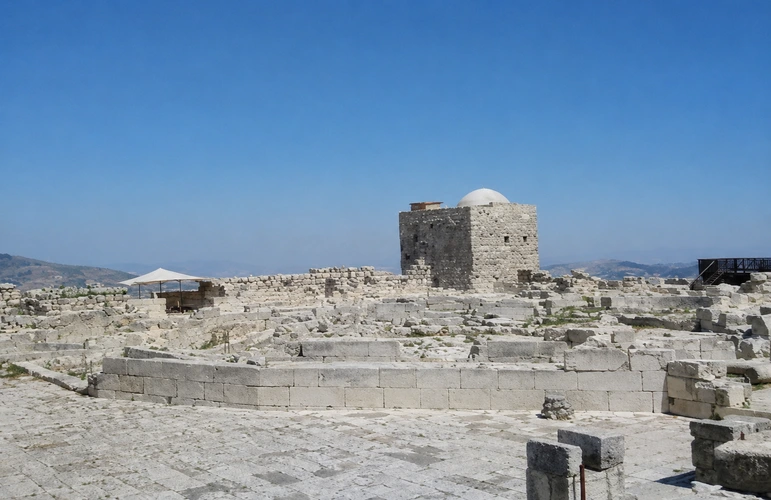
If you are wondering where is Mount Gerizim, it rises just south of the city of Nablus, beside the biblical site of Shechem, in the central Samarian highlands of the West Bank, a region also known in Israel as Judea and Samaria. The mountain reaches about 881 meters (2,890 feet) above sea level and faces Mount Ebal across the Nablus valley. Mount Gerizim is one of the most uniquely sacred sites in the region, serving as the central holy mountain for the Samaritan people for thousands of years.
Where Is Mount Gerizim Located Today?
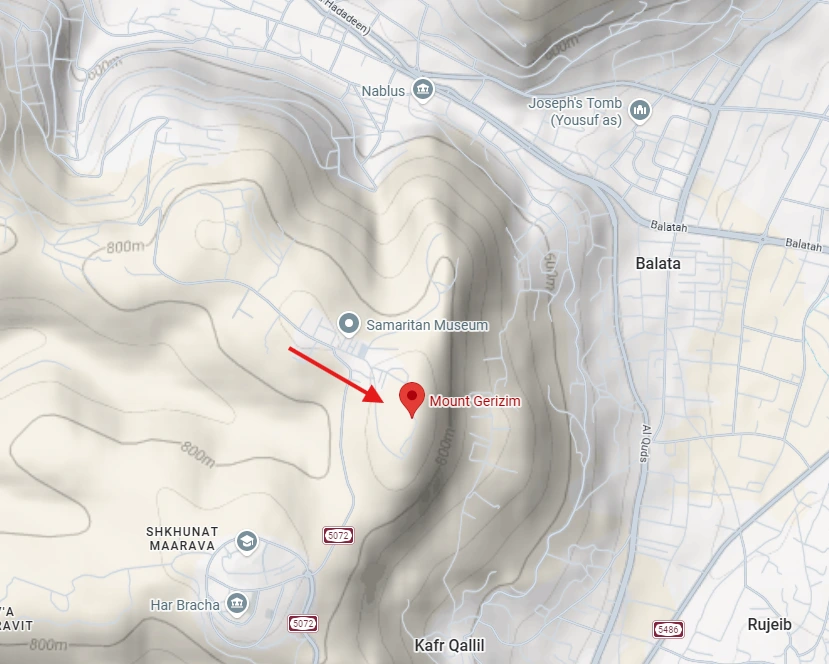
To fully answer where is Mount Gerizim located, we must look at the topography of the central Samarian mountain range. It lies immediately south of Nablus and overlooks the archaeological site of Tell Balata, traditionally identified with biblical Shechem. Across the valley to the north rises Mount Ebal, which stands about 70 meters (230 feet) higher than Gerizim. Geologically, both mountains are formed of hard limestone, standing as remnants in the center of the Nablus syncline. Mount Gerizim is located near Nablus in the West Bank, a territory also commonly referred to in Israel by the biblical names Judea and Samaria.
Mount Gerizim on a Map
When looking at Mount Gerizim on a map, it sits strategically in the central hill country. Its southern position directly above the Nablus valley makes it easy to understand the biblical pairing of Mount Gerizim and Mount Ebal. Atop the mountain ridge, you will find the Samaritan village of Kiryat Luza and the nearby Israeli settlement of Har Brakha.
Why Is Mount Gerizim Important?
Mount Gerizim holds profound significance across multiple disciplines. It possesses immense biblical importance, deep Samaritan religious history, and a wealth of archaeological remains. From ancient temple history to living religious traditions that continue to this day, its towering presence above Shechem and its contrast with Mount Ebal make it a focal point of historical and spiritual identity in the region.
Mount Gerizim in the Bible
To understand Mount Gerizim in the Bible, you must look at the foundational narratives of the Israelites entering the Promised Land. If you are planning a comprehensive Christian Holy Land tour, this mountain provides essential context for Old Testament events.
The Mountain of Blessing
According to the Book of Deuteronomy (11:29), Mount Gerizim was designated as the mountain of blessing, while its twin, Mount Ebal, was designated for curses. The Israelites were instructed to perform a profound covenant ceremony here upon first entering Canaan. The visual geography is striking: Gerizim on the south, Ebal on the north, and Shechem nestled in the valley between them.
Joshua and the Covenant Ceremony
As commanded by Moses, Joshua carried out this blessing-and-curse ceremony after the Israelites entered the land. The tribes were divided, with half standing on Mount Gerizim to pronounce blessings and the other half on Mount Ebal for curses. The mountain therefore became closely linked to covenant, obedience, and Israelite identity.
Jotham’s Parable
In the Book of Judges (chapter 9), Mount Gerizim serves as the stage for the first parable in the Bible. Jotham ascended the summit of Mount Gerizim to deliver the famous “Parable of the Bramble King”. This speech fiercely criticized Abimelech and the people of Shechem.
Why Did the Samaritans Worship on Mount Gerizim?
So, why did the Samaritans worship on Mount Gerizim? According to Samaritan tradition, this is the oldest, most central, and most sacred mountain in the world, chosen by God as the location for a holy temple. Their version of the Pentateuch explicitly identifies Mount Gerizim as the divinely chosen place for worship. Samaritan tradition also associates the mountain with the Binding of Isaac and the Foundation Stone. While Jewish tradition associates the chosen Temple site and Mount Moriah with Jerusalem, Samaritan tradition centers all supreme worship exclusively on Mount Gerizim.
The Mount Gerizim Samaritan Community
The Mount Gerizim Samaritan community represents one of the smallest and most ancient living ethnic groups in the world. Samaritans identify themselves as direct descendants of ancient Israelites. Their faith is strictly based on the Samaritan Pentateuch, and Mount Gerizim remains the absolute spiritual center of their religion. Today, a substantial portion of the global Samaritan population lives in the village of Kiryat Luza on the mountain ridge, while another significant community resides in the city of Holon near Tel Aviv. The entire population numbers roughly 800 individuals.
Samaritan Passover on Mount Gerizim
The Samaritans continue to practice ancient pilgrimage traditions, ascending the mountain three times a year for Passover, Shavuot, and Sukkot. During Passover, they perform the sacrifice of the Paschal lamb on Mount Gerizim according to literal biblical injunctions. This deeply traditional ceremony is one of the most visually distinctive surviving religious practices in the region, drawing many visitors to witness the event.
What Happened on Mount Gerizim?
To fully answer what happened on Mount Gerizim, we must trace its timeline from ancient altars to violent destruction and Byzantine churches.
Persian Period and the Samaritan Temple
Archaeological evidence indicates that a major Samaritan sacred precinct existed on the summit. Excavations suggest that a Samaritan temple dedicated to God was established here in the mid-to-late 5th century BCE during the Persian period. The mountain officially became the rival religious center to Jerusalem.
Hellenistic Expansion
During the Hellenistic period (around the 2nd century BCE), the sacred precinct was expanded substantially to cover an area of 100 by 200 meters. A large settlement, housing perhaps up to 10,000 residents, developed around the temple city. Archaeologists have uncovered markets, houses, streets, shops, and thousands of animal bones from sacrifices, alongside coins and inscriptions.
Destruction by John Hyrcanus
This religious rivalry culminated in violence. In the late 2nd century BCE (around 112–110 BCE), the Hasmonean Jewish ruler John Hyrcanus destroyed the Samaritan temple and its surrounding settlement.
Roman and Byzantine Periods
Despite the temple’s destruction, Samaritans continued to worship on the mountain. During the Roman era, Emperor Hadrian’s forces constructed a temple dedicated to Zeus in the area. In the Byzantine period, Christian authorities barred Samaritans from worshiping there and built an octagonal church dedicated to the Virgin Mary (Theotokos) in 484 CE. Fortifications were later added by Emperor Justinian following violent Samaritan revolts.
Mount Gerizim and Jesus in the New Testament
For those exploring Christian tours of Israel, the mountain offers a powerful New Testament connection. In the Gospel of John (chapter 4), Jesus has a famous conversation with a Samaritan woman at a well. The woman notes the religious dispute, stating her ancestors worshiped on “this mountain,” while the Jews claim Jerusalem is the place to worship. The mountain she refers to is Mount Gerizim. Standing here provides profound physical context for one of the New Testament’s most famous conversations about worship.
What Archaeologists Found on Mount Gerizim
Extensive excavations, including those led by archaeologist Yitzhak Magen, revealed that Mount Gerizim was a functioning religious city. Archaeologists found a fortified sacred precinct, a large temple platform, residential quarters, city walls, and market squares. They also discovered over 400,000 ritual animal bones (sheep, goats, cattle, doves), thousands of ancient coins, pottery, and stone inscriptions bearing the name of God. Remnants of the 5th-century Byzantine octagonal church and its surrounding fortifications were also unearthed.
What Can You See on Mount Gerizim Today?
Today, visitors to the Mount Gerizim Archaeological National Park can explore a rich array of ruins:
- The Samaritan Sacred Precinct: Archaeological remains mark the expanded Hellenistic temple precinct.
- Remains of the Ancient City: Visitors can walk among the ruins of walls, streets, residential homes, and public squares from the Persian and Hellenistic periods.
- Byzantine Church Remains: The outlines of the octagonal church and Justinian’s fortress are clearly visible.
- Altar of Isaac & Giv’ot Olam: You can see the rock where Samaritan tradition believes the Binding of Isaac occurred, and the large rock surface known as the Foundation Stone.
- Sheikh Ghanem’s Tomb: A domed structure in the northeastern corner, tied to Muslim tradition as the tomb of one of Saladin’s soldiers, offering breathtaking views of Nablus, Mount Ebal, and the surrounding Samarian hills.
Is Mount Gerizim Still Sacred Today?
Yes. Mount Gerizim remains the absolute holiest place in the Samaritan religion. It is not merely an archaeological site; it is an active, living sacred landscape. The community continues to live near the summit, perform traditional pilgrimages, and observe sacrifices in a permanent installation designed for the ceremonies.
Visiting Mount Gerizim Today
The archaeological tourism site is managed by the Judea and Samaria Civil Administration and operated by the Israel Nature and Parks Authority. To reach it, travelers generally drive via Route 60, turning toward the community of Har Brakha and following signs through the Samaritan neighborhood. Because access conditions, opening days, entrance fees, and security advisories can change in this geopolitically sensitive area, it is crucial to verify current arrangements before your trip. Coordinating such a complex site is often best managed through a custom Israel tour.
Visiting Mount Gerizim with a Private Guide
A first-time visitor may encounter Byzantine ruins, Samaritan traditions, biblical geography, and modern geopolitics without fully understanding how they connect. Touring with a knowledgeable private Israel tour guide brings the ruins to life. An expert can clearly explain the differences between Jewish and Samaritan theology, the blessing and curse ceremony of Joshua, the archaeological layers of the temple, and safe logistical routing. Whether you are seeking focused day trips or extensive private Israel tour packages, Dekel Tours can build a customized Israel itinerary that perfectly matches your historical and religious interests.
Understanding where is Mount Gerizim provides a window into thousands of years of continuous faith and complex history. From its role as the biblical Mount of Blessing to its status as the enduring spiritual center for the Samaritan people, Mount Gerizim is a testament to the region’s diverse and ancient religious landscape.
Located south of Nablus and near biblical Shechem, it rises opposite Mount Ebal in the central Samarian highlands of the West Bank (also known as Judea and Samaria).
Samaritans believe God chose Mount Gerizim as the sacred center of worship. Samaritan scripture and tradition place unique holiness on the mountain, focusing their ancient temple and pilgrimage traditions entirely on this peak.
The mountain hosted the biblical blessing tradition, an ancient Samaritan temple, and a Hellenistic temple city. Following Hasmonean destruction, it later became the site of a Byzantine church and fortifications, yet continued to host Samaritan worship through the centuries.
Mentioned as the mountain of blessing, Mount Gerizim in the Bible is the site where Joshua conducted the covenant ceremony. It contrasts with Mount Ebal and is also the location where Jotham delivered his famous parable.
Yes, the Mount Gerizim Samaritan community is a living religious group primarily residing in the village of Kiryat Luza. Mount Gerizim remains their absolute spiritual center today.