

How Lot’s Wife Pillar of Salt Looks Today?
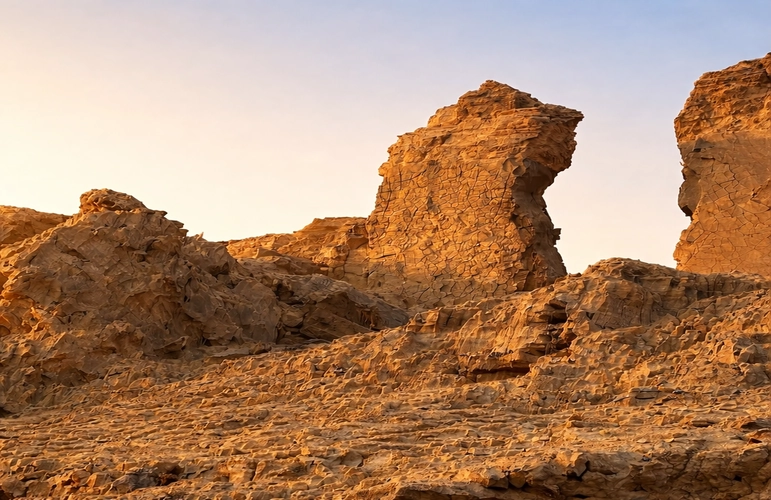
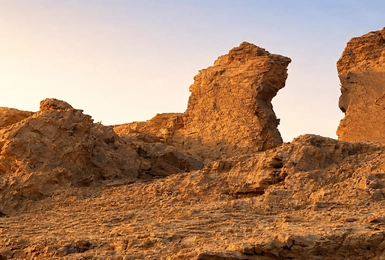
The landscape of the Dead Sea is one of the most surreal on Earth. Between the jagged, sun-scorched mountains of the Judean Desert and the heavy, mineral-rich waters of the lowest point on dry land, lies a region steeped in primordial history. For many travelers and pilgrims trekking through the Holy Land, one specific silhouette stands out against the crags of Mount Sodom: a lone, weathered column of mineral known as Lot’s Wife.
But how does Lot’s Wife pillar of salt look like today? The formation identified as Lot’s Wife is a tall, slender column of mineral and rock salt standing approximately 20 meters (65 feet) high. It is not a human-made statue or an archaeological relic; it is a natural geological formation situated on the eastern slopes of Mount Sodom, overlooking the southern basin of the Dead Sea.
The Biblical Story: A Glance Back at Sodom
The narrative of Lot’s wife is found in Genesis 19, one of the most dramatic chapters in the Old Testament. As the story goes, the cities of Sodom and Gomorrah had become so consumed by wickedness that divine judgment was inevitable. Abraham’s nephew, Lot, lived in Sodom with his family. Two angels arrived to rescue them, leading them out of the city just before fire and sulfur rained from the heavens.
The command was simple but absolute: “Flee for your life! Do not look back, and do not stop anywhere in the Plain” (Genesis 19:17).
As they fled toward the small town of Zoar, the Bible records a haunting moment of hesitation: “But Lot’s wife, from behind him, looked back, and she became a pillar of salt” (Genesis 19:26). While the text does not name her, Jewish Midrashic tradition sometimes refers to her as Irit or Edith. In the New Testament, Jesus uses her as a stark warning about the dangers of clinging to a worldly past, simply stating: “Remember Lot’s wife” (Luke 17:32).
Lot’s Wife Pillar of Salt Location
If you are driving along the shores of the Dead Sea today, you can see the formation that bears her name. The “pillar” is located on the eastern flank of Mount Sodom, at the southern end of the Dead Sea basin. It stands prominently above Highway 90, the main artery running through the Jordan Rift Valley, approximately 12 miles (20 kilometers) south of the Masada fortress.
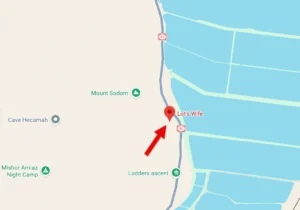
What does it look like?
Rising roughly 20 meters (65 feet) high, the formation is a tall, slender column of rock salt and limestone. From certain angles, particularly when viewed from the road below, the pillar remarkably resembles the shrouded figure of a woman looking back toward the north, the direction traditionally associated with the destroyed cities of the plain.
The surrounding environment of Mount Sodom is a “salt diapir” essentially a mountain made of salt that has been pushed up through the earth’s crust. This creates a landscape of white, crystalline ridges and deep, narrow crevices that look like something from another planet.
Pro Tip: If you are exploring the region on one of our Dead Sea and Masada Private Tours, your guide will lead you to the best vantage points where the “human” silhouette of the pillar is most striking.
A Natural Geological Wonder
While the biblical narrative attributes the pillar’s creation to a miraculous judgment, geologists offer a fascinating look at the natural forces at play in this volatile region.
Mount Sodom is unique because it is composed almost entirely of rock salt (halite). Because salt is less dense than the sedimentary rocks above it, tectonic pressure over thousands of years has pushed the salt upward, much like toothpaste being squeezed from a tube.
The “Pillar of Salt” we see today is the result of:
- Differential Erosion: Salt is highly soluble. Rare but intense desert flash floods and wind-driven sand carve the soft salt into jagged shapes.
- Protective Capping: The pillar survives because it is partially “capped” by harder limestone or clay, which shields the salt underneath from dissolving as quickly as the surrounding rock.
- Constant Change: Because salt is so susceptible to the elements, the “Lot’s Wife” seen by travelers 500 years ago is likely not the exact same physical shape we see today. The mountain is constantly “self-sculpting.”
Ancient References and Historical Mentions
The identification of a specific salt formation as Lot’s wife is not a modern tourist invention. It has been a staple of Mediterranean lore for two thousand years.
The Jewish historian Flavius Josephus, writing in the 1st century CE, claimed to have seen the pillar himself, noting: “I have seen it, and it remains at this day.” Early Christian pilgrims of the Byzantine era also recorded sightings of the salt statue, often describing it as having miraculous properties (such as “healing itself” if a limb was broken off).
It is important to note that throughout history, different formations on Mount Sodom have likely been identified as “the” pillar. As one column erodes and collapses, another emerges through the shifting topography of the salt mountain, ensuring that every generation has a “Lot’s Wife” to look upon.
Religious Significance and Jewish Tradition
For the observant traveler, visiting Lot’s Wife is not just a photo opportunity; it is an encounter with Halacha (Jewish law).
According to Jewish tradition, someone who sees the pillar of salt is encouraged to recite two specific blessings:
- “Blessed be He, the True Judge”: This acknowledges the justice of the punishment meted out to the people of Sodom.
- “Blessed be He who remembers the righteous”: This honors the merit of Abraham, through which Lot and his daughters were saved.
Beyond the formal blessings, the site serves as a profound symbol of the human struggle between moving toward a better future and being paralyzed by an attachment to a sinful or destructive past.
Is This the Original Pillar?
When visitors ask, “Is this the real pillar of salt?” The answer depends on whether you are looking for archaeological proof or spiritual tradition.
From a scientific and archaeological standpoint, there is no way to “date” a salt formation to a specific biblical event in the Bronze Age. Salt is too volatile a material to survive in the exact same shape for 4,000 years.
However, from a cultural and traditional standpoint, the identification of this site on Mount Sodom is deeply rooted in the geography described in the Bible. Whether this specific column is the one mentioned in Genesis, or a natural monument that serves to remind us of the story, it remains the most powerful physical link to the narrative in the world today.
Other “Lot’s Wife” Formations
Interestingly, the tradition is not confined solely to the Israeli side of the Dead Sea. On the Jordanian side, near the Monastery of Saint Lot and the “Cave of Lot,” there is another rock formation that locals and pilgrims identify as Lot’s Wife.
This duality reflects the long history of the region. Since the Dead Sea was a crossroads for pilgrims from all directions, it is natural that traditions would sprout on both banks of the salt sea, both pointing back to the same ancient warning.
Visiting Lot’s Wife Pillar of Salt Today: Practical Info
If you’re planning to see the pillar, it is easily accessible but requires a bit of “desert-readiness.”
- How to get there: The pillar is visible from Highway 90. There is a small pull-off area where you can park and look up.
- Hiking: For a closer look, you can hike the Sodom Canyon or the Fish Trail on Mount Sodom. These trails take you through spectacular salt formations, flour caves, and dramatic desert scenery. If you’re planning to explore the area on foot, check out our complete Mount Sodom hiking guide, which covers the best hiking routes, trail maps, difficulty levels, safety tips, and what to expect along the way.
- Best Time to Visit: We recommend visiting between October and May. The southern Dead Sea can reach temperatures exceeding 45°C (113°F) in the summer, making hiking dangerous.
- Nearby Attractions: You can easily combine a visit here with:
- Masada: Just 15 minutes north.
- Ein Bokek: The hotel and beach district for a float in the Dead Sea.
- The Dead Sea Works: To see the industrial side of this mineral-rich area.
At Dekel Tours, we often make custom tours which include Mount Sodom, providing the historical context that brings these geological “statues” to life.
According to the Bible, she was turned into salt because she disobeyed the angelic command not to look back at the destruction of Sodom. Commentators suggest her “looking back” signaled a longing for the sinful life she was leaving behind, making her heart as cold and “salty” as the city she loved.
In this context, a pillar of salt is a tall, vertical column formed primarily of rock salt (halite). While the biblical pillar was a miraculous occurrence, the pillars seen today on Mount Sodom are geological formations created by the upward movement of salt deposits and subsequent erosion by wind and rain.
The wife of Lot, the nephew of the patriarch Abraham. While she is a central figure in the story of Sodom’s destruction, her name is never mentioned in the Hebrew Bible (Tanakh), though she is a major figure in Jewish and Islamic tradition.
The choice of “salt” is deeply symbolic of the Dead Sea region (the Salt Sea). Salt represents both preservation and desolation. By turning into salt, she became a permanent part of the landscape of judgment that swallowed the cities of the plain.
The formation on Mount Sodom looks like a craggy, white-and-grey limestone column. From the road, it has a distinct “head” and “shoulders” shape, appearing like a woman wearing a long cloak, standing frozen against the mountainside.
The geological formation known as Lot’s Wife stands approximately 20 meters (65 feet) tall. It is a towering, slender column composed primarily of natural rock salt and limestone, rising prominently from the eastern slopes of Mount Sodom above the Dead Sea.