

What Is the History of Masada?
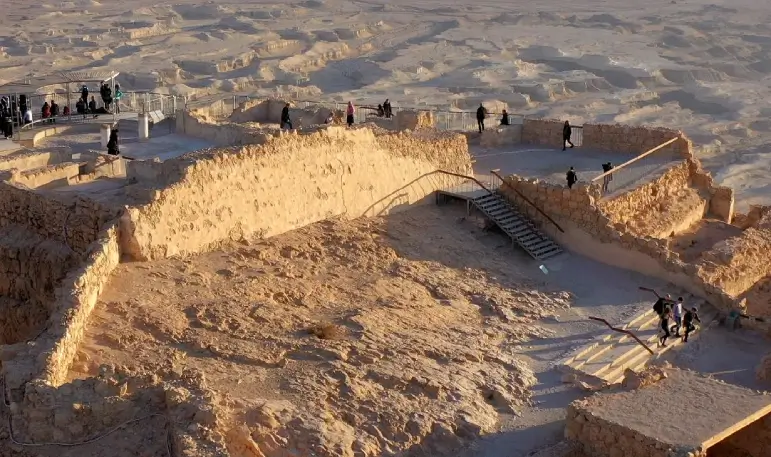
Masada is an ancient mountaintop fortress in Israel’s Judean Desert overlooking the Dead Sea, best known as the site of the final stand of Jewish rebels against the Roman Empire in 73 to 74 AD. Originally fortified by King Herod the Great in the first century BC as a luxurious palace and stronghold, Masada later became a refuge for Jewish Zealots during the Great Revolt. The historical saga culminated in a dramatic siege by Roman forces and a tragic mass suicide, famously recorded by the first-century historian Flavius Josephus.
Today, Masada is far more than a simple archaeological site. It is a powerful symbol of Jewish resistance, a UNESCO World Heritage landmark, and a cornerstone of Israeli tourism. To understand what is the history of Masada you need to explore thousands of years of geopolitical struggles, brilliant engineering, profound tragedy, and modern national identity. For travellers visiting Israel, especially Jewish Americans seeking to connect with their heritage, Masada offers an emotional and educational experience like no other.
Masada From Desert Fortress to Enduring Symbol
To truly grasp the history of Masada, we must view it through both an ancient and a modern lens. Since the geopolitical shifts and tragic events of late 2023, the Jewish diaspora has actively sought out sites that embody survival, resilience, and an eternal connection to the land of Israel. Masada stands as the ultimate testament to these themes. Its story weaves together royal ambition, sheer engineering brilliance, religious rebellion, and a deeply tragic commitment to freedom over enslavement. When you walk among these ruins today, you are stepping into a narrative that has shaped Jewish identity for millennia.
Hasmonean Origins: The Earliest Fortress
The earliest chapter of Masada’s history remains slightly clouded in mystery. According to the ancient Jewish historian Flavius Josephus, the first fortifications on this remote desert plateau were constructed during the Hasmonean period. Josephus credits the high priest Jonathan, often identified by modern scholars as King Alexander Jannaeus in the first century BC, with building the initial stronghold.
However, modern archaeology has yet to confirm clear architectural remains from this early Hasmonean phase. While the idea of a Hasmonean fortress is widely accepted in historical texts, the physical evidence is incredibly limited. Despite this lack of physical proof, the strategic importance of Masada was undeniable from the very beginning. The site sits atop a steep, isolated plateau surrounded by plunging cliffs on all sides, dropping 450 meters to the Dead Sea on its eastern flank. It overlooks vital trade routes and ancient mineral extraction sites. Even in its earliest, unverified phase, Masada was universally recognized as a natural stronghold capable of protecting whoever controlled its commanding heights.
Herod the Great’s Masterpiece (37 to 4 BC)
Masada’s true transformation occurred under King Herod the Great. Known as one of the most ambitious and prolific builders in ancient history, Herod ruled Judea as a client king of the Roman Empire. Herod was famously paranoid, constantly fearing rebellion from his Jewish subjects and external threats from regional rivals like Cleopatra of Egypt. Seeking a secure royal refuge, Herod chose the isolated heights of Masada.
Between 37 and 4 BC, Herod constructed one of the most impressive desert fortresses ever conceived. He turned a barren rock into an impenetrable sanctuary equipped with every luxury imaginable. Instead of settling for basic military barracks, Herod built a lavish Northern Palace that cascaded down three natural rock terraces, offering breathtaking views and secure command centers. On the plateau itself, he constructed a sprawling Western Palace used for administration and housing his royal court.
Herod’s architectural genius lay in his ability to blend Roman luxury with absolute practical defense. He engineered advanced water systems consisting of massive cisterns carved deep into the bedrock. Complex aqueducts captured rare desert flash floods, channeling the water into these cisterns. This brilliant system allowed a large population to survive for years in a harsh desert environment without relying on a vulnerable external water source.
To complement the water supply, Herod built huge warehouse complexes filled with massive clay jars holding grain, oil, wine, and weapons. Surrounding it all were casemate walls consisting of double stone walls filled with earth and punctuated by heavily armed guard towers. He even included Roman style bathhouses with raised floors for heating, ornate mosaics, and beautiful frescoes. Today, visitors can still explore these magnificent ruins, making Masada a visual marvel of the ancient world.
The Great Jewish Revolt (66 to 73 AD)
Masada’s most famous and deeply tragic chapter began during the First Jewish Revolt against Rome. After decades of heavy taxation, religious suppression, and violent tension between the local Jewish population and Roman authorities, a full-scale rebellion erupted in 66 AD.
The Romans responded with brutal, overwhelming force. In 70 AD, the Roman legions commanded by Titus breached the walls of Jerusalem and destroyed the Second Temple. This catastrophic event resulted in the death or enslavement of hundreds of thousands of Jews. However, the destruction of Jerusalem did not immediately bring an end to the war.
A radical Jewish group known as the Sicarii captured Masada from a Roman garrison early in the revolt. The Sicarii derived their name from the small daggers, or sicae, which they concealed in their cloaks to assassinate political opponents. Led by a charismatic and uncompromising commander named Eleazar ben Yair, the Sicarii turned Masada into their ultimate stronghold.
From this isolated desert fortress, the rebels resisted Roman occupation completely. They conducted raids on nearby settlements to secure vital supplies and offered a safe sanctuary to refugees fleeing the destruction of Jerusalem. For a brief, defiant period, Masada became a functioning Jewish community and the very last independent sovereign Jewish territory in the region.
The Roman Siege (73 to 74 AD)
The Roman Empire, driven by an absolute need to project authority, could not tolerate this final pocket of resistance. The sheer existence of an unconquered rebel base was a political embarrassment to Rome. Around 73 or 74 AD, the Roman governor of Judea, Flavius Silva, marched on Masada with the Tenth Legion, formally known as Legio X Fretensis, alongside thousands of auxiliary troops and Jewish prisoners of war.
The Romans faced a staggering logistical and geographical challenge. Masada was nearly impossible to attack directly because the sheer cliffs rendered traditional siege towers and ladders completely useless. To solve this, Silva implemented a methodical and brilliant engineering strategy.
First, the Romans built a massive stone circumvallation wall that completely encircled the base of the mountain. This two-mile wall ensured that no rebel could escape and no reinforcements or supplies could enter. Next, Silva established eight fortified military camps around the base of the mountain to house his thousands of soldiers. The remarkably preserved outlines of these camps are still clearly visible from the summit today, serving as a chilling reminder of the Roman military machine.
The centerpiece of the Roman assault was a gigantic earthen ramp constructed on the western side of the mountain, where the cliff face was slightly less steep. Using enslaved Jewish labor to deter the defenders from throwing stones and arrows, the Romans relentlessly piled thousands of tons of earth and stone to create a gradual incline up to the fortress walls. Once the ramp was completed, the Romans rolled a massive siege tower equipped with a heavy battering ram to the top and began pounding Herod’s casemate wall.
The Final Stand: Tragedy at Masada
According to the highly detailed historical accounts of Flavius Josephus, the Romans successfully breached the outer stone wall, only to find that the Jewish defenders had constructed a secondary inner wall made of wood and earth. When the Romans set this wooden wall on fire, the fate of the fortress was permanently sealed. Silva withdrew his troops for the night, confidently planning to storm the complex at dawn.
Realizing that capture meant a brutal death for the men and a life of horrifying slavery and abuse for the women and children, Eleazar ben Yair gathered his followers. Josephus recounts that Eleazar delivered a passionate speech urging his people to die as free individuals rather than live as Roman slaves.
Because Jewish law strictly forbids suicide, the community devised a tragic plan. The men killed their own families to spare them from the Romans. Ten men were then chosen by lot to kill the remaining men. Finally, one man was chosen to kill the other nine before taking his own life. According to Josephus, exactly 967 men, women, and children perished that night.
When the heavily armed Roman legionaries charged into the fortress the next morning, they were met with an eerie silence. Instead of a fierce battle, they found the burning ruins of the palaces and the bodies of the defenders. Only two women and five children, who had bravely hidden in the underground water cisterns, survived to tell the tale to the Romans.
Modern historians and archaeologists continuously debate the exact details of this account. Questions remain regarding the accuracy of Josephus’s narrative, especially since he was a Jewish general who had defected to the Romans and often blended historical fact with dramatic Roman literary tropes. Were all 967 people present, or did some manage to escape into the unforgiving desert? Despite these academic debates, the core narrative of ultimate sacrifice remains deeply embedded in global historical memory.
Rediscovery and Archaeology
Following the Roman conquest, a small Roman garrison occupied Masada for a short time. Later, during the Byzantine period, a small group of Christian monks lived on the mountain and left behind a modest church. After the Muslim conquest in the seventh century, the site was entirely abandoned and lost to history for hundreds of years.
Masada remained forgotten until its rediscovery in 1838 by American scholars Edward Robinson and Eli Smith, who identified the iconic mountain from a distance using a telescope.
The most significant archaeological work took place between 1963 and 1965 under the leadership of Israeli archaeologist and military general Yigael Yadin. Aided by thousands of passionate international volunteers, Yadin conducted a massive excavation that captivated the young State of Israel. They uncovered the brilliantly preserved floors and frescoes of Herod’s palaces, alongside remnants of the Jewish rebels’ daily lives, including ritual baths and an ancient synagogue. They also found fragments of biblical scrolls and pieces of pottery bearing names. One such pottery shard bore the name Ben Yair, leading scholars to theorize these were the very lots drawn during the final, heartbreaking moments of the siege.
Modern Insights and New Research
The study of Masada is a constantly evolving scientific endeavor. In recent years, modern technological analysis and updated archaeological surveys have challenged some of the traditional assumptions about the famous siege.
For decades, the popular belief was that the Roman siege dragged on for up to three years. However, new logistical analyses of Roman military efficiency and the construction speed of the siege ramp suggest a much shorter timeline. Modern researchers now argue that the Roman siege may have lasted only a few months, and possibly as short as a few weeks. This updated timeline does not diminish the heroism or the tragedy of the event. Instead, it highlights the terrifying, unstoppable efficiency of the Roman military machine and emphasizes the hopeless reality the Jewish defenders ultimately faced.
Masada as a Symbol of Jewish Identity
The cultural meaning of Masada extends far beyond its physical, rocky ruins. Throughout the twentieth century, and especially during the establishment and early survival of the State of Israel, Masada became a foundational pillar of national identity.
The phrase “Masada shall not fall again” became a central, unifying motto in Israeli culture. For decades, elite combat units of the Israel Defense Forces held their swearing in ceremonies at the summit of the mountain under the cover of night, illuminated only by torches. It was a rite of passage that connected young soldiers directly to their ancient warrior ancestors.
In the wake of the severe geopolitical conflicts that erupted in late 2023, the symbolism of Masada has experienced a powerful and deeply emotional resurgence. The themes of protecting the homeland, fighting for freedom against overwhelming odds, and maintaining Jewish sovereignty resonate more deeply with Israelis and Jewish communities worldwide today than they have in decades. Visiting Masada is no longer just a history lesson; it has become a profound act of solidarity, remembrance, and cultural pride.
A UNESCO World Heritage Site
In 2001, the United Nations Educational, Scientific and Cultural Organization officially designated Masada as a World Heritage Site. The organization recognized the mountain fortress for several vital reasons. The dry desert climate kept the ancient structures remarkably intact for two millennia, offering outstanding preservation. Furthermore, Masada offers the most complete and best preserved example of ancient Roman siege works anywhere in the world. Above all, the site serves as a universal, timeless symbol of the human struggle for freedom against overwhelming oppression.
Visiting Masada Today with Dekel Tours
Today, Masada is one of the most iconic and frequently visited travel destinations in Israel. Accessible via the scenic Route 90 along the edge of the Dead Sea, it offers an unforgettable blend of natural beauty, profound history, and spiritual connection.
Visitors have multiple ways to experience the magic of the mountain. Many choose to hike the famous, winding Snake Path before dawn to watch the sunrise illuminate the Moab Mountains of Jordan in brilliant hues of red and gold. Others prefer the modern, air conditioned cable car, which provides a fast and highly accessible ride to the summit for travelers of all ages.
Because of its deep connection to Jewish survival and continuity, Masada is a highly sought after location for major life cycle events. Families traveling from the United States often choose this majestic backdrop for religious milestones. Celebrating a Bar or Bat Mitzvah at the ancient synagogue on Masada bridges the gap between ancient history and the modern Jewish future in a way that simply cannot be replicated anywhere else.
Masada is rarely visited in total isolation. It is perfectly situated to be the highlight of a broader exploration of southern Israel. A well planned trip will combine the heavy historical weight of Masada with the natural wonders of the surrounding area. Families frequently pair a morning at the fortress with an afternoon floating effortlessly in the mineral rich waters of the Dead Sea or hiking through the refreshing waterfalls of the Ein Gedi Nature Reserve.
For those looking to craft the perfect multi day journey that perfectly balances education, adventure, and relaxation, integrating Masada into a custom family itinerary is absolutely essential.
Why Masada Matters Today
History is only as important as the modern lessons we draw from it. Masada continues to captivate millions of people because it tells a distinctly, fiercely human story. It forces every visitor to confront difficult questions about the tension between freedom and survival, the terrible cost of resistance, and the enduring power of collective identity.
For Jewish Americans and global travelers alike, standing on the dusty plateau of Masada is not just an exercise in viewing ancient ruins. It is a vital moment of connection with a defining historical event that permanently shaped the destiny of the Jewish people. In today’s complex and often challenging geopolitical climate, visiting Masada serves as a grounding, incredibly powerful reminder of a heritage that has survived empires, sieges, and millennia.
The primary construction and monumental fortification of Masada took place during the reign of King Herod the Great from 37 to 4 BC. However, ancient historians suggest that the very first fortifications were established earlier, during the Hasmonean period in the first century BC, though archaeological evidence for this earlier phase is still debated by scholars today.
While earlier, smaller fortifications may have existed, Masada as we know it today was extensively developed by King Herod the Great. Between 37 and 4 BC, Herod transformed the barren mountain into a highly secure desert stronghold, constructing luxurious palaces, enormous storage facilities, complex water cisterns, and heavy defensive walls.
The fortress rises approximately 450 meters (1,476 feet) above the level of the Dead Sea, which is the lowest point on Earth. On its western side, where the Roman siege ramp was built, it stands about 58 meters (190 feet) above the surrounding desert plateau. The incredibly steep cliffs made Masada an ideal, naturally defensible location that required incredible engineering to conquer.
Masada was the site of the final, tragic holdout of Jewish rebels known as the Sicarii against the mighty Roman Empire during the First Jewish Revolt. Following a massive Roman siege in 73 to 74 AD, the Romans breached the fortress walls using a gigantic earthen ramp. According to ancient historical accounts, the 967 Jewish defenders chose to commit mass suicide rather than submit to Roman capture, torture, and slavery.
Masada is located in southern Israel, deep within the remote Judean Desert, overlooking the western shore of the Dead Sea. It sits approximately 20 kilometers (12 miles) east of the city of Arad. The striking elevation and isolated nature of the plateau make it one of the most dramatic and instantly recognizable landscapes in the entire country.